

We use hand sanitizer every day, right? As a hand sanitizer manufacturer, are you aware that in the fierce market competition, are large, economical bottles more popular, or are small, portable, and convenient bottles more marketable? Let’s explore this together.
Advantages and Market Performance of Large Bottles of Hand Sanitizer
Larger Capacity, More Economical
A significant advantage of large bottles of hand sanitizer is their economic benefits. From a cost perspective, large bottles of hand sanitizer have a larger production volume per batch, resulting in a lower production cost per milliliter. This makes them more competitively priced compared to smaller bottles. For example, the 525ml bottle of Walch antibacterial hand sanitizer is 10%-20% cheaper per milliliter than smaller bottles of the same brand. For families, especially larger families, or in high-traffic, crowded environments like offices, large bottles of hand sanitizer can meet substantial usage needs, reducing the cost of frequent purchases and resulting in significant savings over the long term.
Reduced Purchase Frequency
Buying large bottles of hand sanitizer significantly reduces the frequency of purchases. In daily life, whether at home or in public places, frequent purchases of hand sanitizer are undoubtedly time-consuming and energy-draining. The large capacity of large bottles meets long-term usage needs. For an average family of three, using a 500ml bottle of hand sanitizer with normal handwashing frequency, it can last 1-2 months, unlike smaller bottles which may require purchases every few weeks. For busy office workers or procurement staff in large corporations, reduced purchase frequency means more time and energy can be devoted to more important work and life matters, improving overall life and work efficiency.
Market Share and Applicable Scenarios
In terms of market share, large bottles of hand sanitizer occupy a considerable proportion in many places such as homes, hotels, restaurants, and schools. In the household market, according to market research data, large-bottle hand sanitizers account for over 60% of the market share. This is mainly due to the long-term, stable demand for cleaning products from households, as well as the affordability of large-bottle hand sanitizers. In the hotel industry, for cost control and ease of management, large-bottle hand sanitizers have become standard equipment in guest rooms and public areas, meeting the needs of a large number of guests. The same applies to restaurants; customers wash their hands frequently before and after meals, and large-bottle hand sanitizers ensure a sufficient supply at all times, guaranteeing the quality of hygiene services. In schools, with a large student population and high usage, large-bottle hand sanitizers effectively reduce procurement and management costs, providing a stable guarantee of hand hygiene on campus.
Highlights and Target Audience Preferences of Small-Bottle Hand Sanitizers
Compact and Portable, Clean Anytime
The biggest highlight of small-bottle hand sanitizers is their compact and portable nature. In today’s fast-paced life, people are often on the move. Whether it’s frequent business travelers, backpackers who love to travel, or commuters squeezing onto subways and buses, small-bottle hand sanitizers can easily fit into pockets, bags, suitcases, etc., taking up almost no space. Take Dettol’s 50ml bottle of hand sanitizer as an example. Its compact size allows it to easily fit in a jeans pocket, making it convenient for users to clean their hands anytime, anywhere, before dining out or after touching public items. This effectively reduces the risk of bacteria and viruses, ensuring personal hygiene. When traveling, whether on a plane, train, or at a tourist attraction, the small bottle of hand sanitizer is always useful, allowing people to enjoy their trip while keeping their hands clean.
Precise Dosing, Avoiding Waste
Small bottles of hand sanitizer offer a unique advantage in dosage control. Due to their smaller size, users can more accurately control the amount used each time. For those with less dirt on their hands or who tend to use less, large bottles of hand sanitizer can easily dispense too much, leading to waste. Small bottles solve this problem effectively. For example, children have smaller hands and require less hand sanitizer; small bottles are easier for them to use, preventing waste caused by excessive dosage. Moreover, the small bottle design of hand sanitizer ensures a relatively fixed amount is used each time. For consumers who value environmental protection and resource conservation, the waste-reducing characteristic of small-bottle hand sanitizer undoubtedly aligns better with their values.
Target Group and Purchase Motivation
The main target groups for small-bottle hand sanitizer include frequent travelers, those with high personal hygiene standards, and young consumers. Business travelers who frequently travel between different cities and locations need to keep their hands clean at all times; the portability of small-bottle hand sanitizer meets their need for on-the-go handwashing. Those with high personal hygiene standards, such as medical professionals and food industry workers, pay close attention to hand hygiene both at work and in daily life; small-bottle hand sanitizer allows them to disinfect their hands anytime, ensuring their own and others’ health and safety. Young consumers, especially students and young working professionals, pursue a fashionable and convenient lifestyle. The elegant appearance and portability of small-bottle hand sanitizer resonate with their attitude, making it an essential part of their daily hygiene routine. For them, purchasing small-bottle hand sanitizer is not only about meeting cleaning needs but also an expression of their pursuit of a fashionable and convenient lifestyle.
Packaging Factors Affecting Hand Sanitizer Sales
Packaging style has a significant impact on hand sanitizer sales. Luxury hand sanitizer packaging typically uses exquisite materials, such as glass with gold or silver accents, elegant colors, and a delicate texture. This creates a high-end, sophisticated atmosphere, satisfying consumers’ pursuit of a quality lifestyle and attracting those who value a high-quality life and a sense of ritual. These consumers are often willing to pay a higher price for luxurious packaging and a superior product experience. For example, some high-end hotels choose luxuriously packaged hand sanitizers to enhance their image and prestige. Minimalist packaging, characterized by clean lines, pure colors, and simple logos, gives a simple and stylish feel, aligning with the modern consumer’s pursuit of a simple and efficient lifestyle. It is suitable for consumers who prefer simplicity and dislike overly complicated decorations. Placed in a modern minimalist home environment, it blends in well, showcasing the homeowner’s aesthetic taste.
Packaging is a direct reflection of a brand’s image and values. Well-designed packaging can convey a brand’s positioning, philosophy, and personality to consumers. For example, hand sanitizer brands that emphasize natural and gentle ingredients might use natural colors like green and brown on their packaging, paired with plant illustrations and simple text descriptions. This allows consumers to immediately perceive the product’s natural attributes and gentle nature, attracting consumers who value natural ingredients and gentle skincare. Brands that emphasize antibacterial and disinfecting functions will highlight relevant labels and instructions on their packaging, such as “99.9% antibacterial,” along with images representing cleaning and disinfection. This provides consumers with a sense of security, meets their needs for health protection, and attracts consumers who prioritize hygiene and health. Brands can also convey their values through slogans and stories on the packaging, such as caring for family, environmental protection, and pursuing quality. This evokes emotional resonance with consumers, making them see hand sanitizer as more than just a cleaning product; it’s about choosing a lifestyle that aligns with their values.
Hand Sanitizer Packaging Machines
Semi-Automatic Liquid Filling Machines
Semi-automatic liquid filling machines are one of the most commonly used pieces of equipment in hand sanitizer packaging. Taking Zhongkai Packaging’s semi-automatic liquid filling machine as an example, this type of machine operates on a semi-automatic piston design. This filling machine uses a cylinder to drive a piston to draw in and dispense material. A one-way valve cleverly controls the material flow, and a reed switch precisely controls the cylinder’s stroke, allowing for flexible adjustment of the filling volume. While manual assistance is required, this very requirement provides high operational flexibility. The operator places the empty bottle at the designated filling position and presses the start button; the machine then begins operation. The cylinder drives the piston to draw in hand sanitizer and precisely inject it into the bottle. The filling volume can be set on the control panel according to actual needs.
This filling machine is ideal for small hand sanitizer manufacturers, as well as for small-batch production or production scenarios with diverse product types. Small businesses, with limited production scale and capital, can benefit from the relatively low price of semi-automatic liquid filling machines, effectively controlling equipment procurement costs. Furthermore, in small-batch production or with diverse product types, it can quickly adjust the filling volume and speed according to different production tasks without complex equipment debugging processes, greatly improving production efficiency and adaptability. For example, some handmade specialty hand sanitizer workshops may have small production volumes but offer a wide variety of products. Semi-automatic liquid filling machines can effectively meet their production needs, helping them efficiently complete the packaging of hand sanitizer.
Integrated Filling and Capping Machines
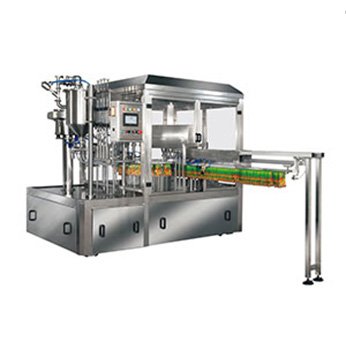
Integrated filling and capping machines represent a higher degree of automation. Taking Wenzhou Yeqi’s integrated filling and capping machine as an example, it combines filling and capping functions into one, achieving a one-stop automated operation from hand sanitizer filling to cap tightening. This equipment mainly consists of a conveying system, a filling system, a capping system, and a control system. The conveying system uses high-quality conveyor belts to smoothly transport empty bottles to each workstation, and precise positioning devices ensure accurate bottle placement during filling and capping. The filling system’s material tank stores the hand sanitizer raw materials, and the equipped liquid level monitoring device monitors the liquid level in real time. When the liquid level is too low, an alarm is triggered to remind staff to add material, ensuring continuous production. Metering pumps or filling valves, as core components of the filling system, precisely control the filling volume with minimal error. Filling heads are typically designed in a multi-head configuration, significantly improving filling efficiency.
The capping system’s capping head, driven by a motor, accurately grasps and screws caps onto the bottle. The cap conveying device, using a vibratory feeder or linear feeder, orderly transports caps to the area below the capping head, ensuring a smooth capping process. The control system employs an advanced PLC (Programmable Logic Controller) and a touchscreen human-machine interface. Operators can easily automate the equipment by simply setting parameters on the touchscreen, and can also monitor the equipment’s operating status in real time, perform fault diagnosis, and record data. This integrated machine offers significant advantages: it greatly improves production efficiency, reduces manual operation, lowers labor costs and human error, and ensures consistent and stable product packaging. For large-scale hand sanitizer manufacturers, the integrated filling and capping machine is an ideal choice for improving production efficiency and ensuring product quality, meeting their needs for efficient and precise production.