

Until you need them, some products function better when stored separately than together. Combine epoxy resin with hardener days before use? In the container, it solidifies.
By 2026, two-ingredient packaging will not only be wise but also necessary due to market needs and regulatory authorities.
Here’s what’s evolving, why it matters, and how the appropriate tools increase productivity while safeguarding your goods.
What Are 2-Ingredient Liquid Filling Machines?
The idea is simple. Two liquids kept together in a single package that shouldn’t come into contact until needed.
Typical formats for packaging consist of:
- Bottles with two chambers (side-by-side or stacked)
- Breakable internal seals in burst pouches
- Systems with dual cartridges for accurate dispensing
- Medical uses using dual syringe configurations
Consider the items you use on a daily basis. Your garage’s two-part epoxy. kits for coloring hair at the drugstore. Until application, all components must be separated.
2026 Regulatory Standards Reshaping Dual-Component Packaging
GMP and FDA Compliance Get Stricter
For 2026, pharmaceutical regulators increased regulations considerably.
Among the new mandates are:
- Validation of sterile filling for both chambers (not just one)
- Full traceability for every component with batch tracking
- Data integrity systems that concurrently monitor both fill lines
- Preventing contamination by using closed-system filling
Reconstitution systems must now maintain sterility throughout the filling process, according to FDA regulations.
Food Safety Standards Acknowledge
Dual-Chamber, as a Critical HACCP and ISO 22000 process, has been developed. Packaging is currently considered an important control point in food safety management systems.
Requirements for 2026 demand:
- Cross-contamination is avoided via hygienic design. CIP (Clean-In-Place) and SIP (Sterilize-In-Place) capabilities
- All surfaces in touch with the product are made of stainless steel 316L.
- Strict procedures for separating allergens
These criteria are included in the pharmaceutical-grade stainless steel construction and precise dosing systems of Sumbpack’s liquid filling machines, which ensure food safety throughout the production process.
Why More Industries Are Switching to Dual-Component Filling Systems
Pharmaceutical Manufacturing Leads
Applications include oral suspensions (active ingredient powder mixed with flavored liquid), injectable biologics (lyophilized drug with sterile water), antibiotic reconstitution (powder with diluent), and combination therapy (two medications that would interact if pre-mixed).
Adhesives and Industrial Chemicals
Industrial spaces are dominated by silicones, polyurethanes, and two-component epoxies. Pre-measured dual packing is advantageous for construction supplies, marine coatings, and industrial sealants.
Cosmetics Chasing Premium Positioning
Consumer appeal drives sales. “Freshly activated” messaging commands premium pricing. Ingredients demonstrably stay potent until the moment of use. It’s marketing backed by real chemistry.
Spout pouch filling and capping machines handle liquid components with precision, making them adaptable for dual-component packaging in food and cosmetic applications.
How Modern Dual-Chamber Filling Systems Work
Step 1: Orient and Inspect Bottles
As dual-chamber bottles come into line, they are automatically positioned, and their chamber integrity is examined.
Step 2: Fill Both Chambers
For accuracy, two-head filling operates simultaneously, utilizing volumetric or piston dosing.
Step 3: Secure and Seal
The primary cap is put when the internal barriers have sealed. Protection is improved by optional tamper-evident or induction sealing.
Step 4: Quality Assessment and Rejection
Each bottle is verified by leak testing, eye inspection, and inline weighing. Defective items are automatically eliminated.
Step 5: High-Speed Output
Accurate dual-component filling is provided by configured Sumbpack rotary systems at up to 60 units per minute.
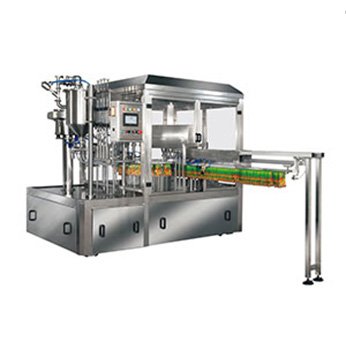
Sumbpack’s rotary liquid filling machines can be configured for dual-component applications, offering precise control over both chambers with speeds up to 60 units per minute.
Safety and Efficiency Benefits You Can’t Ignore
Cleaner production: Contaminants and pathogens are kept out by sealed filling systems. From filling to ultimate usage, both chambers remain sterile.
Exact measurements: Both materials are properly measured by the machine. Your product will function exactly as intended if the accuracy is within ±0.5-1%.
Longer shelf life: Ingredients stay fresh because they don’t mix until use. Instead of lasting weeks, products last years. Energy and money are saved since less refrigeration is required.
Reduced waste: Accurate filling eliminates overfilling. Longer shelf life reduces the amount of expired goods that are discarded.
Reduced expenses: Purchasing and maintaining two distinct goods is replaced by a single dual-chamber package. Less warehousing space is required. Inventory tracking gets easier.
Consistent quality: Each and every unit is produced in the same way. Automated checks quickly identify issues. Paperwork related to regulations is completed automatically.
Pick the Ideal Packaging Format for Your Application
- Medicines, skincare items, and specialty chemicals (10 ml to 1 liter per side) are all suitable for bottles.
- Pouches are useful for food products (2 grams to 6 pounds), adhesives, and single-use items.
- Cartridges are useful for industrial applications and medical equipment that require precise ratios (5 ml to 300 ml).
Match Your Filling Machine to Your Production Volume
Starting with your monthly output makes selecting the appropriate filling equipment much simpler. The correct match reduces costs, increases productivity, and avoids bottlenecks.
Less than 10,000 units a month?
The best option is typically a semi-automatic filler. It is accurate, reasonably priced, and ideal for small-batch manufacturing or new companies.
10,000–100,000 units a month?
You’re prepared for a completely automated system. Automation lets you scale without hiring more staff, minimizes manual labor, and maintains consistency in your production.
More than 100,000 units a month?
Rotating lines at high speeds become crucial. These machines facilitate large-scale manufacturing without slowing down, operate constantly, and provide excellent accuracy.
Why Sumbpack Machines Are Built for 2026 and Beyond
The 6-station rotary machines from Sumbpack are perfect for expanding companies because they provide robust speed, consistent precision, and a seamless automation transfer. Our larger systems grow with your volume, so your investment is future-proof.
Know Your Industry Requirements
Every business has its own set of regulations, and selecting the incorrect machine might cause problems with compliance. Customers, your goods, and your brand are all protected by the appropriate equipment.
Pharmaceuticals: You require equipment that supports cleanroom compatibility and complete validation. Sumbpack equipment is made to adhere to stringent pharmaceutical regulations.
Food Products: HACCP-compliant, easily cleaned systems are necessary for oil, sauces, and edible liquids. Hygiene is simple with our stainless-steel designs.
Cosmetics: GMP-ready, hygienic equipment is essential for beauty and skincare companies. Every time, our machines provide uniform, clean fills.
Industrial Chemicals: Safe, long-lasting systems are necessary for handling corrosive or reactive liquids. Chemical-resistant setups designed for harsh locations are available from Sumbpack.
Upgrade to 2026-Ready Filling Technology with Sumbpack
Sumbpack’s 2,000+ unique solutions and 15 years of packaging experience assist manufacturers across sectors in achieving the 2026 criteria. Our liquid filling systems provide the accuracy, security, and productivity that contemporary manufacturing requires.
Contact us today:
- Call or WhatsApp: +86 13106736449
- Email: niki@sumbpack.com
- Request a consultation to know how dual-component filling technology transforms your production
Free packaging design consultation and CAD drawings included with every inquiry.
Frequently Asked Questions
Why would two-ingredient liquid filling devices be so crucial in 2026?
Products with two components are becoming more common in the food, cosmetics, adhesives, and pharmaceutical industries. Cleaner filling techniques, improved traceability, and total ingredient separation up until the point of use are now required by regulations for 2026. These devices enable the achievement of those requirements while enhancing the performance and stability of the product.
What kinds of goods require packaging with two chambers or two ingredients?
This includes anything that degrades, becomes unstable, or activates when combined. Two-part epoxies, medical reconstitution products, hair color kits, high-end cosmetics formulae, and specific food concentrates are a few examples. If the chemistry only works when mixed right before use, dual-component packaging is essential.
How is the mixing of two ingredients prevented in a two-ingredient liquid filling machine?
The method takes advantage of airtight chamber separation, distinct filling routes, and distinct nozzles. Every component is filled separately, sealed right away, and watched over by leak-detection and vision systems. Until the client purposefully mixes the two substances, machines never permit them to come into contact.
Can these devices process thick materials, gels, or powders?
Yes. Powders are supported in one chamber and liquids in another in several arrangements. While volumetric or flow-meter systems accurately handle thinner liquids, piston fillers are capable of handling viscous gels, resins, and pastes for industrial or cosmetic purposes.
Which sectors stand to gain the most from dual-ingredient filling technology?
For sterile reconstitution goods, pharmaceutical companies depend on it. It is used in two-part curing processes by chemical and adhesive firms. Dual-chamber packaging is used by cosmetics companies to offer “fresh-activation” goods. For mixes that degrade easily when pre-blended, food makers employ burst-pouch systems.