
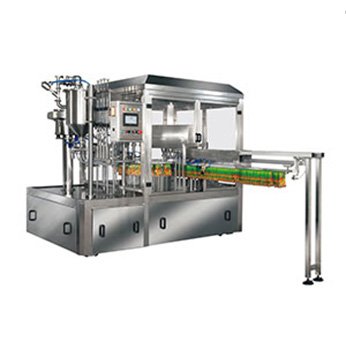

To satisfy market needs, modern oil production facilities need sanitary and effective filling systems. Manual filling processes are wasteful, ineffective, and unable to meet production demands.
In addition to lowering costs and improving product quality, automatic oil packaging machines offer precise filling, quick operation, and increased cleanliness.
Understanding Automatic Oil Packaging Equipment: Function and Importance
With little assistance from a person, an automatic oil packing machine fills bottles, pouches, or containers.
Because oil has different viscosities and is slick, packing it can be difficult. The proper handling techniques are needed for each type.
Filling by hand is inconsistent and ineffective. While fully automated systems handle all tasks, including bottle positioning and cap sealing, semi-automated systems need operators to position bottles.
How Automatic Oil Packaging Machines Work: Technology and Core Operating Principles
To effectively handle a variety of oil types, automatic oil packing machines integrate engineering solutions with precision controls.
Product Preparation and Feeding
To make it easier for viscous oils to flow, oil is kept in big tanks and heated gradually as needed.
Systems for Dosing and Measuring
Precise measurement is necessary for accurate filling; machines use sensors and flow meters to measure the precise amount of oil that is dispensed into each container.
Nozzle and Dispensing Technology
Oil flow into containers is controlled by specialized nozzles. Multi-nozzle layouts boost throughput, diving nozzles limit foam formation, and anti-drip designs reduce spillage.
Container Handling Systems
Bottles are precisely positioned under filling nozzles and travel along conveyors. While sensors identify missing or misaligned bottles to avoid filling problems, timing screws maintain consistent spacing.
Integrated Automation and Controls
Machine operations are controlled via a touchscreen interface and a central programmable logic controller (PLC). Operators may monitor system performance, program recipes for various oils, and change settings.
Inside the Oil Packaging Process: How Automatic Filling Lines Work Step-by-Step
The steps in the packaging process are as follows:
Step 1: Bottles that are empty are transported and automatically aligned.
Step 2: Metering and Oil Feeding Pipes carry oil from storage tanks to distributing nozzles.
Step 3: Accurate Filling Bottles are filled by nozzles in accordance with preset weight, volume, or flow rate criteria.
Step 4: Capping and Sealing In order to maintain freshness for edible oils, induction sealing forms a protective layer inside the cap.
Step 5: Labeling and Coding Labels can be put automatically in front, back, or wrap-around configurations.
Step 6: Final Quality Assessment Checkweighers weigh every bottle. Rejected units are those that fall outside of allowable parameters.
Key Features That Define Modern Automatic Oil Packaging Machines
Modern oil packaging equipment has a number of benefits.
High accuracy: Accuracy of filling within ±0.1–0.3%
Versatility: Suitable for both heavy lubricants and thin cooking oils
Construction: SS304 or SS316 stainless steel to ensure food safety
Sanitary design: Satisfies food industry standards and makes cleaning easier.
Quick changeover: Makes it possible to transition between bottle sizes effectively
Leak-Proof Nozzles: These reduce spills and waste
Overload protection and emergency stops are examples of safety measures.
Full integration, Compliant with unified production lines for labeling, capping, and filling
Contact Sumbpack to get expert guidance and transparent pricing.
Types of Oil Filling Machines and Where Each One Works Best
Volumetric Filling Machines
These devices use fixed volume measures to fill bottles. They work well with basic food oils like sunflower or soybean oil.
Flow Meter Filling Machines
These devices use magnetic or mass sensors to measure oil with extreme precision. They work best with cold-pressed and quality oils.
Piston Filling Machines
intended for heavy, viscous liquids like lubricants and motor oil. Precise filling is ensured by a piston system that supplies oil with controlled force.
Gravity Filling Machines
Ideal for oils that flow freely and are thin. For basic cooking oils, oil flows readily into bottles, offering a straightforward and affordable option.
Pouch Filling Machines
These devices add oil to flexible pouches or sachets. They are frequently utilized for single-serving quantities and small retail containers.
Industry-Wise Applications of Oil Packaging Machines
Edible Oil Sector
Cooking oils such as sunflower, soybean, mustard, coconut, and mixed types are packaged by these machines.
Automotive Oils and Lubricants
Because of their high viscosity, hydraulic, gear, and engine oils need to be handled carefully.
Industrial Oils and Chemicals
Solvents, mineral oils, and industrial fluids all require materials that are resistant to chemicals.
Consumer goods and contract packaging
Fast-moving consumer goods require high-speed production lines.
Why Today’s Manufacturers Rely on Automatic Oil Packaging Machines for Higher Efficiency
For oil producers, automation offers several benefits:
- Accuracy: Accurate filling lowers waste and boosts revenue.
- Speed: Hundreds or thousands of bottles can be filled by machines in an hour.
- Consistency: Brand reputation is improved by uniform bottle weight and look.
- Hygiene: Automated cleaning systems and stainless steel structure adhere to food safety standards.
- Cost reduction: Operating costs are reduced when there is less manual work.
- Scalability: Systems can grow with production.
Ready to upgrade your production line? Talk to our experts and get a custom oil packaging solution built for your output needs.
Choosing the Right Automatic Oil Packaging Machine for Your Production Needs
The bottling process has been revolutionized by automatic oil packing devices.
These systems achieve exceptional filling precision by integrating pumps, sensors, nozzles, and sophisticated controls. They minimize waste, run quickly, and uphold hygienic requirements.
Automation provides speed, accuracy, and dependability when packing industrial lubricants or cooking oil.
Get in touch with Sumbpack to explore your unique needs for automated oil packaging solutions.
Frequently Asked Questions
How do volumetric, piston, and flow meter filling machines differ from one another?
Fillers with volume: For edible oils, measure by volume.
- Piston fillers: Suitable for lubricants and high-viscosity fluids, they use force to disperse heavy oils.
- Flow meter fillers: For outstanding precision, use sensors like mass flow or magnetic meters; perfect for high-end oils.
What kinds of oils are suitable for automatic oil packing equipment?
Different types of oil are accommodated by automatic oil packing equipment, such as:
- Sunflower, mustard, soybean, and coconut oils are edible.
- Industrial oils (mineral oils, solvents)
- Lubricants and automotive oils (engine oil, gear oil, hydraulic oil)
From thin to thick oils, modern systems easily adjust to different viscosities.
How precise is the automatic oil packaging machinery?
The filling accuracy of most modern machines is between ±0.1% and ±0.3%. To guarantee constant fill levels with little variation, they use servo systems, flow meters, and load cells.
Is it possible for a single machine to fill different bottle sizes?
Yes. A lot of automated systems can quickly switch between several container sizes, such as 200 ml bottles, 1L bottles, or 20L jerry cans. Through the touchscreen interface, operators can quickly switch between formats using preset filling procedures.
How do filling machines avoid spills or drips?
To avoid splashing and foam formation, the majority of systems use diving nozzles that extend inside bottles and anti-drip nozzles. These characteristics minimize product waste and keep the workspace tidy.
Can food-grade oils be used with these machines?
Yes. Food-grade oil packaging machines include hygienic designs, support Clean-in-Place (CIP) systems for automated cleaning, and are made of stainless steel (SS304 or SS316).